Saturday, August 6, 2011

WORLD WAR II: BEFORE THE WAR


The years leading up to the declaration of war between the Axis and Allied powers in 1939 were tumultuous times for people across the globe. The Great Depression had started a decade before, leaving much of the world unemployed and desperate. Nationalism was sweeping through Germany, and it chafed against the punitive measures of the Versailles Treaty that had ended World War I. China and the Empire of Japan had been at war since Japanese troops invaded Manchuria in 1931. Germany, Italy, and Japan were testing the newly founded League of Nations with multiple invasions and occupations of nearby countries, and felt emboldened when they encountered no meaningful consequences. The Spanish Civil War broke out in 1936, becoming a rehearsal of sorts for the upcoming World War -- Germany and Italy supported the nationalist rebels led by General Francisco Franco, and some 40,000 foreign nationals traveled to Spain to fight in what they saw as the larger war against fascism. In the last few pre-war years, Nazi Germany blazed the path to conflict -- rearming, signing a non-aggression treaty with the USSR, annexing Austria, and invading Czechoslovakia. Meanwhile, the United States passed several Neutrality Acts, trying to avoid foreign entanglements as it reeled from the Depression and the Dust Bowl years.


Adolf Hitler, age 35, on his release from Landesberg Prison, on December 20, 1924. Hitler had been convicted of treason for his role in an attempted coup in 1923 called the Beer Hall Putsch. This photograph was taken shortly after he finished dictating "Mein Kampf" to deputy Rudolf Hess. Eight years later, Hitler would be sworn in as Chancellor of Germany, in 1933.


A Japanese soldier stands guard over part of the captured Great Wall of China in 1937, during the Second Sino-Japanese War. The Empire of Japan and the Republic of China had been at war intermittently since 1931, but the conflict escalated in 1937.


Japanese aircraft carry out a bombing run over targets in China in 1937.  


Japanese soldiers involved in street fighting in Shanghai, China in 1937. The battle of Shanghai lasted from August through November of 1937, eventually involving nearly one million troops. In the end, Shanghai fell to the Japanese, after over 150,000 casualties combined.


First pictures of the Japanese occupation of Peiping (Beijing) in China, on August 13, 1937. Under the banner of the rising sun, Japanese troops are shown passing from the Chinese City of Peiping into the Tartar City through Chen-men, the main gate leading onward to the palaces in the Forbidden City. Just a stone's throw away is the American Embassy, where American residents of Peiping flocked when Sino-Japanese hostilities were at their worst.


Japanese soldiers execute captured Chinese soldiers with bayonets in a trench as other Japanese soldiers watchfrom rim.


Chinese General Chiang Kai-shek, right, head of the Nanking government at Canton, with General Lung Yun, chairman of the Yunan provincial government in Nanking, on June 27, 1936. 


On Feb. 5, 1938, A Chinese woman surveys the remains of her family, all of whom met death during Japanese occupation of Nanking, allegedly victims of atrocities at the hands of Japanese soldiers.


Buddhist priests of the Big Asakusa Temple prepare for the Second Sino-Japanese War as they wear gas masks during training against future aerial attacks in Tokyo, Japan, on May 30, 1936.


Italian Fascist leader Benito Mussolini, center, hands on hips, with members of the fascist Party, in Rome, Italy, Oct. 28, 1922, following their March on Rome. This march was an act of intimidation, where thousands of fascist blackshirts occupied strategic positions throughout much of Italy. Following the march, King Emanuelle III asked Mussolini to form a new government, clearing the way towards a dictatorship


Four Italian soldiers taking aim in Ethiopia in 1935, during the Second Italo-Abyssinian War. Italian forces under Mussolini invaded and annexed Ethiopia, folding it into a colony named Italian East Africa along with Eritrea.


Italian troops raise the Italian flag over Macalle, Ethiopia in 1935. Emperor Haile Selassie's appeals the the League of Nations for help went unanswered, and Italy was largely given a free hand to do as it pleased in East Africa.


In Spain, loyalist soldiers teach target practice to women who are learning to defend the city of Barcelona against fascist rebel troops of general Francisco Franco during the Spanish Civil War, on June 2, 1937. 


Three hundred fascist insurgents were killed in this explosion in Madrid, Spain, under the five-story Casa Blanca building, on March 19, 1938. Government loyalists tunneled 600 yards over a six-month period to lay the land mine that caused the explosion. 


An insurgent fighter tosses a hand grenade over a barbed wire fence and into loyalist soldiers with machine guns blazing in Burgos, Spain, on Sept. 12, 1936.


German-made Stuka dive bombers, part of the Condor Legion, in flight above Spain on May 30, 1939, during the Spanish Civil War. The black-and-white "X" on the tail and wings is Saint Andrew's Cross, the insignia of Franco's Nationalist Air Force. The Condor Legion was composed of volunteers from the German Army and Air Force.


Scores of families are seen taking refuge underground on a Madrid subway platform, on Dec. 9, 1936, as bombs are dropped by Franco's rebel aircraft overhead.


Aerial bombing of Barcelona in 1938 by Franco's Nationalist Air Force. The Spanish Civil War saw some of the earliest extensive use of aerial bombardment of civilian targets, and the development of new terror bombing techniques.


Following an aerial attack on Madrid from 16 rebel planes from Tetuan, Spanish Morocco, relatives of those trapped in ruined houses appeal for news of their loved ones, Jan. 8, 1937. The faces of these women reflect the horror non-combatants are suffering in the civil struggle.


A Spanish rebel who surrendered is led to a summary court martial, as popular front volunteers and civil guards jeer, July 27, 1936, in Madrid, Spain.


A fascist machine gun squad, backed up by expert riflemen, hold a position along the rugged Huesca front in northern Spain, Dec. 30, 1936. 


Solemnly promising the nation his utmost effort to keep the country neutral, U.S. President Franklin D. Roosevelt is shown as he addressed the nation by radio from the White House in Washington, Sept. 3, 1939. In the years leading up to the war, the U.S. Congress passed several Neutrality Acts, pledging to stay (officially) out of the conflict.


Riette Kahn is shown at the wheel of an ambulance donated by the American movie industry to the Spanish government in Los Angeles, California, on Sept. 18, 1937. The Hollywood Caravan to Spain will first tour the U.S. to raise funds to "help the defenders of Spanish democracy" in the Spanish Civil War.


Two American Nazis in uniform stand in the doorway of their New York City office, on April 1, 1932, when the headquarters opened. "NSDAP" stands for Nationalsozialistische Deutsche Arbeiterpartei, or, in English, National Socialist German Workers' Party, normally shortened to just "Nazi Party".


About to be engulfed in a gigantic dust cloud is a peaceful little ranch in Boise City, Oklahoma where the topsoil is being dried and blown away during the years of the Dust Bowl in central North America. Severe drought, poor farming techniques and devastating storms rendered millions of acres of farmland useless. This photo was taken on April 15, 1935. 


Florence Thompson with three of her children in a photograph known as "Migrant Mother." This famous image is one of a series of photographs that photographer Dorothea Lange made of Florence Thompson and her children in early 1936 in Nipomo, California. 


The zeppelin Hindenburg floats past the Empire State Building over Manhattan on Aug. 8, 1936. The German airship was en route to Lakehurst, New Jersey, from Germany. The Hindenburg would later explode in a spectacular fireball above Lakehurst on May 6, 1937.


England's biggest demonstration of its readiness to go through a gas attack was staged, March 16, 1938, when 2,000 volunteers in Birmingham donned gas masks and went through an elaborate drill. These three firemen were fully equipped, from rubber boots to masks, for the mock gas "invasion".


Adolf Hitler of Germany and Benito Mussolini of Italy greet each other as they meet at the airfield in Venice, Italy, on June 14, 1934. Mussolini and his fascists put on a show for Hitler, but on the details of their subsequent conversations there was little news.


Four Nazi troops sing in front of the Berlin branch of the Woolworth Co. store during the movement to boycott Jewish presence in Germany, in March, 1933. The Hitlerites believe the founder of the Woolworth Co. was Jewish. 


The Nazi booth at a radio exhibition which started in Berlin on August 19, 1932. The booth is designed as propaganda of the Nazi gramophone plate industry which produces only records of the national socialist movement.


Thousands of young men flocked to hang upon the words of their leader, Reichsfuhrer Adolf Hitler, as he addressed the convention of the National Socialist Party in Nuremberg, Germany on Sept. 11, 1935. 


Adolf Hitler is shown being cheered as he rides through the streets of Munich, Germany, November 9, 1933, during the celebration of the 10th anniversary of the National Socialist movement.


Hitler youth honor an unknown soldier by forming a swastika symbol on Aug. 27, 1933 in Germany. 


The German army demonstrated its might before more than a million residents during the nationwide harvest festival at Bückeburg, near Hanover, Germany, on Oct. 4, 1935. Here are scores of tanks lined up just before the demonstration began. Defying provisions of the Treaty of Versailles, Germany began rearming itself at a rapid rate shortly after Hitler came to power in 1933.


Thousand of Germans participate in the Great National Socialistic meeting in Berlin, Germany, on July 9, 1932.


A group of German girls line up to learn musical culture under auspices of the Nazi Youth Movement, in Berlin, Germany on Feb. 24, 1936.


Hitler's Nazi party convention, underway in Nuremberg, Germany, on Sept. 10, 1935.


America's Jesse Owens, center, salutes during the presentation of his gold medal for the long jump on August 11, 1936, after defeating Nazi Germany's Lutz Long, right, during the 1936 Summer Olympics in Berlin. Naoto Tajima of Japan, left, placed third. Owens triumphed in the track and field competition by winning four gold medals in the 100-meter and 200-meter dashes, long jump and 400-meter relay. He was the first athlete to win four gold medals at a single Olympic Games.


Members of the Nazi Youth participate in burning books, Buecherverbrennung, in Salzburg, Austria, on April 30, 1938. The public burning of books that were condemned as un-German, or Jewish-Marxist was a common activity in Nazi Germany.


Mass gymnastics were the feature of the "Day of Community" at Nuremberg, Germany on September 8, 1938 and Adolf Hitler watched the huge demonstrations given on the Zeppelin Field.


Windows of shops owned by Jews which were broken during a coordinated anti-Jewish demonstration in Berlin, known as Kristallnacht, on Nov. 10, 1938. Nazi authorities turned a blind eye as SA stormtroopers and civilians destroyed storefronts with hammers, leaving the streets covered in pieces of smashed windows. Ninety-one Jews were killed, and 30,000 Jewish men were taken to concentration camps.


View of one of the large halls of the Rheinmetall-borsig Armament factories at Duesseldorf, Germany, on August 13, 1939, where gun barrels are the main output. Before the start of the war, German factories were cranking out pieces of military machinery measured in the hundreds per year. Soon it climbed into the tens of thousands. In 1944 alone, over 25,000 fighter planes were built.


While newly-annexed Austria awaited the arrival of Adolf Hitler, preparations were underway. Streets were decorated and street names were changed. A workman in Vienna City square carries a new name plate for the square, renaming it "Adolf Hitler Place" on March 14, 1938.


Credit to Sources:


Thursday, June 16, 2011

Saturday, June 4, 2011

British spies swap cupcake recipes into al-Qaida magazine


Readers of al-Qaida's "Inspire" magazine got a tasty surprise thanks to British intelligence operatives: recipes, courtesy of "The Ellen DeGeneres Show," for mini cupcakes.

British spies reportedly hacked into the website of the English-language quarterly published by al-Qaida in the Arabian Peninsula last year, swapping in the cupcake recipes to replace the bombmaking how-to guides set to appear in an article entitled "Make a Bomb in the Kitchen of Your Mom."

"When followers tried to download the 67-page colour magazine, instead of instructions about how to 'Make a bomb in the Kitchen of your Mom' by 'The AQ Chef' they were greeted with garbled computer code," the Daily Telegraph's Duncan Gardham writes.

"The code, which had been inserted into the original magazine by the British intelligence hackers, was actually a web page of recipes for 'The Best Cupcakes in America' published by the Ellen DeGeneres chat show," Gardham wrote.

"The little cupcake is big again," the cupcake feature said. "Self-contained and satisfying, it summons memories of childhood even as it's updated for today's sweet-toothed hipsters."

"We're increasingly using cybertools as part of our work," a British government official--speaking anonymously, of course--told the Associated Press, as he confirmed the hacking operation.

The spy-hacking operation was reportedly conducted by officials with Britain's foreign intelligence service, MI6, and eavesdropping agency, the GCHQ. Since the whole operation was kept under wraps, one can only surmise that the MI6 agents involved were making an additional political statement about the extremely patriarchal outlook of militant Islam by selecting a cupcake recipe endorsed by a well-known lesbian talk show host

"Inspire" magazine, which began publishing last year, is reportedly the editorial brain-child of the Yemen-based, New Mexican-born Islamist radical Anwar al-Awlaki, who has become a propaganda chief for al-Qaida's Yemeni offshoot.

Several recent suspects in terrorist attacks targeting the United States have reportedly been inspired by the English-speaking al-Awlaki. Among them: Umar Farouk Abdulmutallab, the wealthy, Nigerian-born London university student who was charged with attempting to blow up a Christmas Day 2009 flight to Detroit; and Maj. Malik Nadal Hasan, the Army psychiatrist charged with killing 13 fellow soldiers in a 2009 attack on troops at Ft. Hood, Texas.

The United States reportedly targeted al-Awlaki for a drone attack last month but missed.


http://news.yahoo.com/s/yblog_theenvoy/20110603/ts_yblog_theenvoy/british-spies-swap-cupcake-recipes-into-al-qaeda-magazine


Wednesday, May 25, 2011

RULES FOR A HAPPY DAY...........

1. TODAY I WILL NOT STRIKE BACK:
 If someone is rude, if someone is impatient, if someone is unkind... I will not respond in a like manner.

2. TODAY I WILL ASK GOD TO BLESS MY "ENEMY:"
 If I come across someone who treats me harshly or unfairly, I will quietly ask GOD to bless that individual. I understand the "enemy" could be a family member, neighbor, co-worker or stranger.

3. TODAY I WILL BE CAREFUL ABOUT WHAT I SAY:
 I will carefully choose and guard my words being certain that I do not spread gossip.

4. TODAY I WILL GO THE EXTRA MILE:
 I will find ways to help share the burden of another person.

5. TODAY I WILL FORGIVE:
 I will forgive any hurts or injuries that come my way.

6. TODAY I WILL DO SOMETHING NICE FOR SOMEONE, BUT I WILL NOT DO IT SECRETLY:
 I will reach out anonymously and bless the life of another.

7. TODAY I WILL TREAT OTHERS THE WAY I WISH TO BE TREATED:
 I will practice the golden rule - "Do unto others as I would have them do unto me" - with everyone I encounter.

8. TODAY I WILL RAISE THE SPIRITS OF SOMEONE WHO IS DISCOURAGED:
 My smile, my words, my expression of support, can make the difference to someone who is wrestling with life.

9. TODAY I WILL NURTURE MY BODY:
 I will eat less; I will eat only healthy foods. I will thank GOD for my body.

10. TODAY I WILL GROW SPIRITUALLY:
 I will spend a little more time in prayer today: I will begin reading something spiritual or inspirational today; I will find a quiet place (at some point during this day) and listen to GOD's voice!!!


"But since we belong to the day, let us be self controlled, putting on faith and love as a breastplate, and hope of salvation as a helmet."
 1 Thessalonians 5:8


Sunday, May 8, 2011

6 devices the US Navy SEALs used to corner bin Laden


Curious about what kinds of gadgets the US Navy SEALS used to track and bring down the numero uno terror threat known as Osama bin Laden? Check out the gallery below and see the devices used against the terror kingpin that sure could do wonders for our country's own armed forces.


Flash Bang

Ah, FB (no, not Facebook), one of the most popular (and cheapest) items you could buy in the game Counter-Strike. Guess what? It does have its real-world uses, too, as it was used to help the Navy SEALS penetrate Osama's compound by blinding their enemies.


Helmet-mounted cameras

The commandos that raided bin Laden's compound used helmet-mounted cameras that were connected via Satellite and were useful for receiving and relaying tactical information to and from HQ. Think of it these as the eyes of those who aren't really physically part of the operation.


Stealth Drone

Ah, the Stealth Drone, specifically the Lockheed Martin RQ-170, one of them military toys that we really want to see in action. This one right here boasts a humongous 20m wingspan and can fly at 15,000 freakin' meters while sending important surveillance information to the troops who are in the safety of their bases.


Terain-Following Radar

This instrument helped pilots to maneuver across Pakistan's valleys especially while cruising in low-altitudes and low-light situations. Installed on the US' MH-60 helicopters (which we will go to next), the Terrain-Following Radar probably played an important role both in navigation and surveillance.


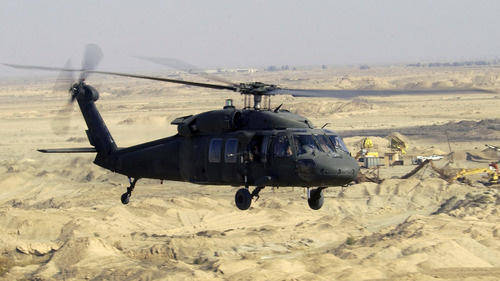
Stealth MH-60 Black Hawk helicopter

They're lean, they're mean and they're definitely armed to the teeth. The MH-60 Black Hawk helicopters come with 3 types of guns with ammo, infra-red jammers, a host of other nifty military-grade devices and space for 11 soldiers. Needless to say, they're like choppers on steroids.


Short-barreled machine guns and assault rifles

Of course you couldn't kill Osama with choppers, radar and Flash Bangs, right? Well you can but it would be really messy. Here's where the short-barreled machine guns and assault rifles like the M4 Assault Rifle and MP7 Submachine Gun enter the picture. They're lightweight and compact enough to bring inside Osama's compound. And, yes, they're high-powered, too, as supported by the corpses found after the dust has settled inside the hideout.
 Posted on: 05/07/11 by Neps Firmalan Tagged as terrorism, Osama bin Laden, Al-Qaeda, US Navy Seals, army, armed forces, tactics, Taliban


Sunday, May 1, 2011

10 Natural Wonders to See Before They Disappear By Sean O'Neill

You've heard the grim timelines: if warming continues, the Great Barrier Reef will be bleached by 2030; glaciers in the Swiss Alps, on Mt. Kilimanjaro, and in Glacier National Park will disappear in under 40 years; and Arctic ice melt will leave the North Pole bare and polar bears extinct. The immediacy of these timelines prompts flocks of curious eco-tourists to travel to environmentally fragile areas. Tourism is both bane and boon: it can add strain to already distressed areas, but it can also provide income, which in turn can help preserve these wonders. In time for Earth Day, we spotlight 10 areas under threat—some lesser known than others—that can still be visited responsibly.


The Belize Barrier Reef

 
The Belize Barrier Reef is one of the most
diverse reef ecosystems in the world, home
to whale sharks, rays, and manatees as well
as sturgeon, conch and spiny lobsters.
Perhaps the most famous site from the reef
is this one, of the Great Blue Hole.
One of the most diverse reef ecosystems in the world is home to whale sharks, rays, and manatees, as well as sturgeon, conch and spiny lobsters.

The Threat: Like the Great Barrier Reef in Australia, the Belize Barrier Reef leads a tenuous existence. A section of the nearly 700-mile-long Mesoamerican Reef that reaches from Mexico to Honduras, the Belize reef suffered a severe bleaching in 1998, with a loss of 50 percent of its coral in many areas, including much of its distinctive staghorn coral. Since the bleaching, its decline has continued, due to global warming of the world's seas, agricultural pollution, development, and increasing tourism, which has given rise to more coastal development and an invasion of cruise ship.

The Congo Basin


Roads cut by loggers and miners have also enabled poachers and bushmeat hunters to prey on endangered animals like bonobos (pictured), forest elephants, and okapis.
Photo: Courtesy © Frans Lanting/Corbis
Tropical rainforests like the Congo Basin produce 40 percent of the world's oxygen and serve as a vital source of food, medicine and minerals.

The Threat: At more than 1.3 million square miles, the Congo Basin has the world's second-largest rainforest, after the Amazon's. According to the UN up to two-thirds of the forest and its unique plants and wildlife could be lost by 2040 unless more effective measures are taken to protect it. Extending across six nations, ten million acres of forest is degraded each year due to mining, illegal logging, farming, ranching, and guerilla warfare. Roads cut by loggers and miners have also enabled poachers and bushmeat hunters to prey on endangered animals like mountain gorillas, forest elephants, bonobos, and okapis. As the forest shrinks, less carbon dioxide is absorbed, and rain decreases, adding to climate change.

The Dead Sea


The Dead Sea is the lowest spot on earth (1,312 feet below sea level), has 10 times more saline than seawater (so humans float like corks), and is believed to contain therapeutic minerals.
Photo: Courtesy LiorDrZ?/Getty
It's the lowest spot on earth (1,312 feet below sea level), has 10 times more saline than seawater (so humans float like corks), and is believed to contain therapeutic minerals.

The Threat: In the last four decades, the Dead Sea has shrunk by a third and sunk 80 feet—13 inches per year!—stranding formerly seaside resorts and restaurants nearly a mile from shore. The Jordan River is the lake's sole source, and as surrounding countries increasingly tap its waters, little reaches the Dead Sea, which could disappear within 50 years. Further pressure is put on the sea by the cosmetic companies and potash producers who drain it for minerals. One proposed solution is the controversial Red-Dead Canal, channeling water 112 miles from the Red Sea, but its environmental impact could be negative (some worry that it would increase seismic activity in the region).

The Everglades


At least 20 species in the Everglades are endangered including panthers, turtles, manatees, and great white egrets (shown here).

This 2.5 million–acre wetland encompasses cypress swamps, mangroves, sawgrass and pine savannahs. It's the only place in the world where crocodiles and alligators share territory.

The Threat: A host of dangers are putting this fragile wetland at risk: pollution from farms, invasive species, and encroaching development, not to mention the fact that 60 percent of the region's water is being diverted to nearby cities and farms. As a result, The Everglades is now half the size it was in 1900. Worse, this is the sole habitat of the Florida panther, and there are less than 100 of the creatures left in the wild. These big cats may be completely lost within the next 40 years as their habitat disappears (they're not alone, either—at least 20 species in the Everglades are endangered, including turtles, manatees, and wading birds).

Madagascar


Erosion is also a concern in Madagascar. The Betsiboka River, above, is red thanks to the large quantity of sediment it carries to the sea.
Photo: Courtesy oledoe/Flickr
More than 80 percent of Madagascar's flora and fauna are found nowhere else on Earth, thanks to millions of years of isolation in the Indian Ocean off of Africa.

The Threat: If nothing is done to save the world's fourth-largest island, its forests will be gone in 35 years (once 120,000 square miles, they're now down to 20,000), and their unique inhabitants along with them. Forest ecosystems are being destroyed by logging, burning for subsistence farms, and poaching. The 20 species of lemurs for which Madagascar is renowned are in danger of disappearing. Though there are game reserves, they're not large (occupying only five percent of the island), nor are they contiguous, thus failing to provide corridors for the animals to travel through. Some of Madagascar's endemic species have never even been recorded, and will likely be lost before they can be studied. 

The Maldives


Only 200 of the islands of the Maldives are inhabited, and none rise higher than eight feet above sea level. Few scientists hold out much hope for the country if global warming continues to melt the ice caps and raise sea levels. Shown here: Baa Atoll.
Photo: Courtesy Sakis Papadopoulos/Getty
The nation is rich in coral reefs and endangered fish—like the giant Napolean wrasse, leopard shark, and some 250 manta rays (most with wingspans of 10 feet).

The Threat: Few scientists hold out much hope for the Maldives—the world's lowest nation—if global warming continues to melt the ice caps and raise sea levels. Its 1,190 small islands and atolls (200 of which are inhabited) scattered across the Indian Ocean rise a mere eight feet above sea level. In 2008, the President of the Maldives announced the government would start buying land in other countries, including India, for future homes for citizens displaced by rising waters. In 2009, he held a cabinet meeting underwater to stress the islands' vulnerability.

The Poles


In the Arctic, the polar bear is also endangered by the steady loss of sea ice, which has decreased 3 percent per decade since the 1970s.
The natural phenomena here are unique and inspiring: towering icebergs, Aurora Borealis, and majestic animals (penguins, polar bears, whales).

The Threat: The Woods Hole Oceanographic Institute, the world's largest non-profit ocean research group, has predicted that 80 percent of the emperor penguin population of Antarctica will be lost, and the rest in danger of extinction, if global warming continues. In the Arctic, the polar bear is also endangered by the steady loss of sea ice (which has decreased 3 percent per decade since the 1970s). As sea ice disappears at the poles, so do entire ecosystems: the phytoplankton that grows under ice sheets feeds zooplankton and small crustaceans like krill, which are on the food chain for fish, seals, whales, polar bears and penguins. Studies predict that with continued warming, within 20-40 years, no ice will form in Antarctica.

Rajasthan, Ranthambore


One of the best places in the world to see tigers.
The Threat: The world's population of wild tigers has fallen to as few as 3,200, more than half of which live in India. If extreme efforts are not undertaken, the big cat may be extinct within our lifetime—possibly in as soon as a dozen years. (Compare this number to the 100,000 tigers that lived in India in 1900 and you can see just how drastically things have changed in the past two centuries.) Their habitats have been reduced 93 percent, and though there are reserves across Asia, most are small and have no corridors between them for the normally far-roaming felines. It's estimated that a tiger a day is killed for use in Chinese traditional medicine.

The Tahuamanú Rainforest


Parrots and macaws feed off of the world's largest salt lick. They share this pristine wonderland with endangered creatures like giant armadillos, ocelots, jaguars, and giant otters.
The Threat: This magnificent rain forest in Peru's Madre de Dios region holds some of the last old-growth stands of mahogany in South America. But illegal logging is depleting the rainforest—and the U.S. is responsible for buying 80 percent of the mahogany. A single tree can create as much as $1 million worth of furniture. Loggers build roads, allowing farmers and hunters to enter, further crowding the indigenous people and destroying the delicate ecosystem. In nearby areas, gold mining has released mercury into the air and water.

The Yangtze River Basin


Exotic creatures like giant pandas, dwarf blue sheep, Yangtze finless porpoises, and Siberian cranes call this region home—along with some 400 million people.

The Threat: It's too early to know the exact impact of the creation of China's massive, $24 billion Three Gorges Dam, but many, including the Chinese government, have acknowledged that the Yangtze Basin region is in danger of losing its most distinctive marine and animal life. Deforestation has occurred from clearing land for displaced farmers, and the reservoir has flooded villages, farms, factories, and mines, adding to the Yangtze River's existing pollution from shipping, industry, agriculture and raw sewage. Landslides have also happened, and seismologists wonder if the water pressure above two fault lines might result in a disastrous earthquake.